Industrial Generator Trends for 2026: What the Market Is Signaling
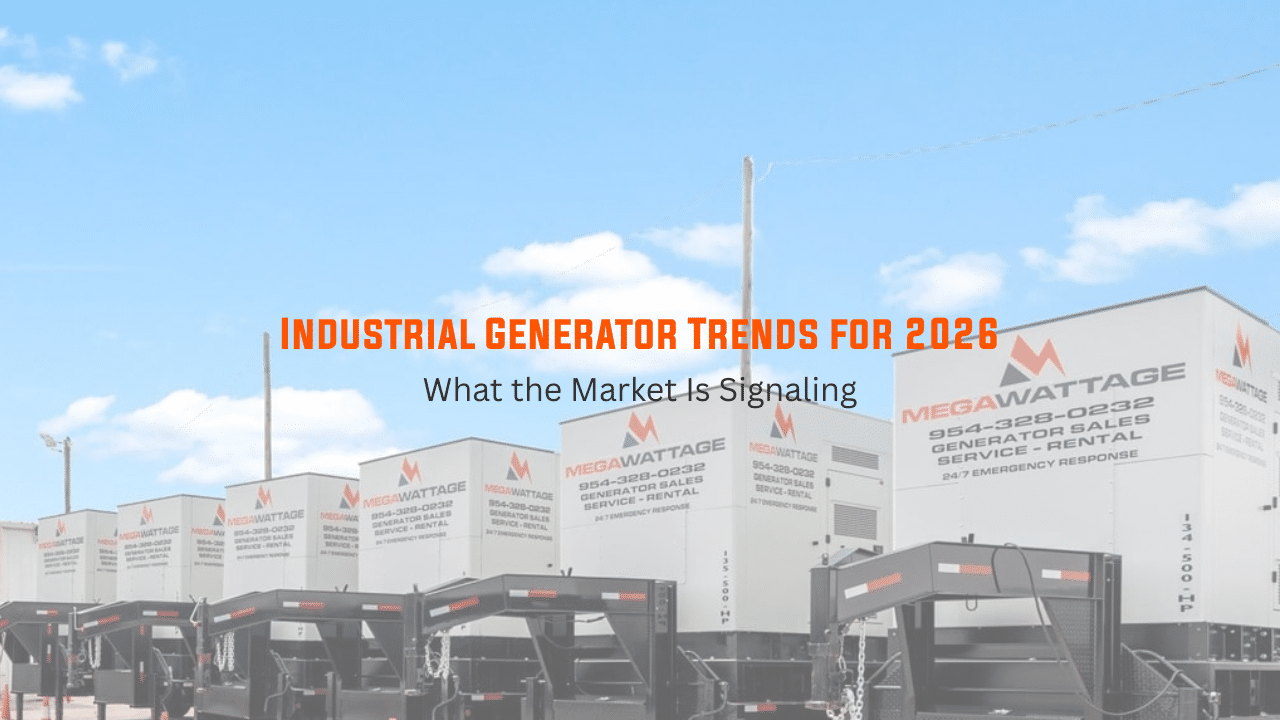
As we move into 2026, one thing is clear: industrial generators are no longer just emergency equipment — they are becoming strategic infrastructure.
From data centers to hospitals to commercial high-rises, power reliability is now tied directly to operational continuity, revenue protection, and risk mitigation. The market signals for 2026 point toward steady growth, smarter technology, and a stronger focus on resilience planning.
Here’s what the industry is showing us — and what facility managers, property owners, and operators should expect in the year ahead.
A Market That’s Expanding — Not Slowing
The global industrial generator market continues to grow at a healthy pace, driven by rising electricity demand, grid strain, and expanding infrastructure development. Analysts project steady compound annual growth over the next several years, fueled by increasing reliance on backup and supplemental power.
What’s behind this growth?
Two major forces:
– Rising industrial load demand
– Grid instability in key regions
In the United States alone, electricity demand is climbing due to manufacturing reshoring, electrification initiatives, and rapid expansion of AI-driven data centers. When the grid is stretched, backup power stops being optional.
For commercial buildings in high-density areas like South Florida, where storms and grid stress are part of the landscape, this trend feels especially relevant.
Generators Are Becoming Prime Power — Not Just Backup
Historically, industrial generators were standby assets — tested monthly and activated during outages.
In 2026, that mindset is shifting.
Large data centers, critical infrastructure sites, and industrial facilities are increasingly using generators in prime or supplemental power roles, not just emergency standby. In some regions, on-site generation is being used to manage peak load costs or bridge gaps in utility capacity.
This shift changes how systems are sized, maintained, and monitored. It also increases the importance of fuel quality, maintenance planning, and load testing because runtime expectations are higher than ever.
Technology Is Raising the Bar
The generators of 2026 are far more intelligent than those of a decade ago.
Integrated remote monitoring, IoT sensors, and predictive diagnostics are quickly becoming standard. Facility managers now expect real-time alerts, runtime analytics, and performance tracking. Not just a red light on a control panel.
Predictive maintenance is also gaining traction. Instead of waiting for failure, facilities are using performance data to anticipate service needs, reducing downtime and extending equipment life.
For companies managing multiple properties or mission-critical sites, this level of visibility is becoming essential.
Clean Fuel and Emissions Awareness Are Front and Center
Environmental regulations continue to evolve, especially in urban markets.
While diesel remains dominant in industrial applications, there is increasing interest in:
– Lower-emission systems
– Dual-fuel capabilities
– Hybrid generator integrations
– Microgrid compatibility
At the same time, fuel quality is under greater scrutiny. Contaminated diesel can compromise performance, increase emissions, and cause costly failures — especially during high-demand periods.
In 2026, generator performance will be tied not just to equipment quality, but to fuel integrity and proactive maintenance strategies.
Resilience Planning Is Becoming More Sophisticated
Perhaps the most important shift in 2026 is mindset.
Businesses are no longer asking, “Do we need a generator?”
They’re asking:
– Is our generator sized correctly?
– Is our fuel supply secure?
– How quickly can we deploy emergency fuel?
– Do we have redundancy?
– Are we testing under real load conditions?
Hurricanes, grid overloads, extreme weather events, and infrastructure upgrades all reinforce one reality: downtime is expensive.
In regions like South Florida, where storm preparedness is non-negotiable, industrial generator planning is moving from compliance-driven to strategy-driven.
What to Expect for the Rest of 2026
Looking ahead, several themes will define the industrial generator market:
– Continued steady growth in demand
– Increased investment in monitoring and automation
– More emphasis on fuel quality and maintenance
– Greater integration with smart building systems
– Rising expectations around uptime guarantees
Generators will continue evolving from emergency equipment into core operational assets.
For facility managers, property owners, and critical infrastructure operators, the message is clear: 2026 is about preparedness, performance, and proactive planning.