★★★★★
3 months ago
“Michael levandoski,this is best tech we can have in years.”
Home » MegaWattage Blog » Cold Storage and the Cost of a Single Degree
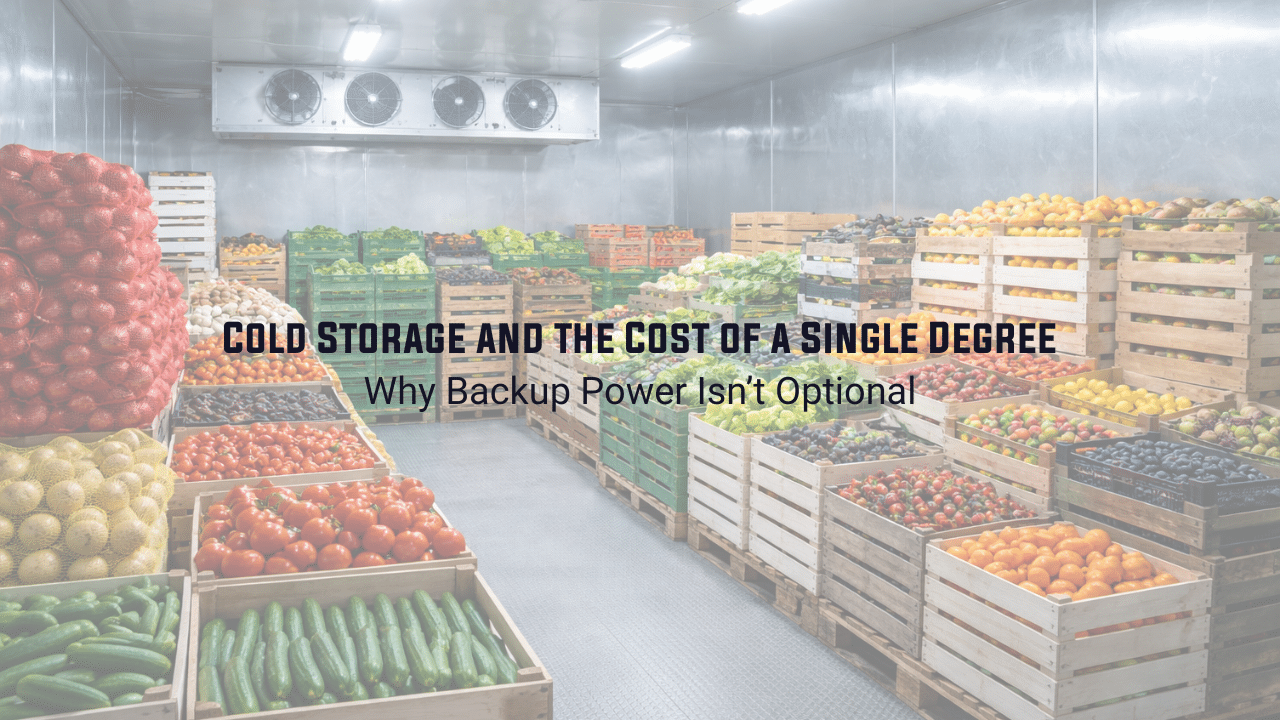
Cold storage facilities live in a world measured by degrees.
One or two degrees may not sound dramatic in an office building or warehouse. But inside a cold storage environment — whether it’s food distribution, pharmaceuticals, or temperature-sensitive materials — a single degree can mean spoilage, regulatory violations, lost contracts, and irreversible financial damage.
Backup power in these facilities isn’t about convenience. It’s about survival.
The Illusion of “Short Outages”
Many facilities plan around the idea that outages will be brief. The assumption is that refrigeration systems can “ride through” short disruptions without serious impact. In reality, cold storage is uniquely vulnerable the moment power is lost.
When refrigeration shuts down, temperature drift begins immediately. Even if doors stay closed, thermal load continues to build. The larger the facility, the longer it may take for temperatures to visibly rise — but that delay can be deceptive. By the time alarms trigger or staff notices changes, the clock has already been ticking.
For frozen goods, thawing and refreezing can destroy product integrity. For refrigerated goods, bacteria growth can accelerate rapidly once temperatures move outside compliance ranges. For pharmaceuticals, even brief deviations can void entire inventories.
There is no such thing as a “wait it out” strategy in cold storage.
Restart Is Not Instant
One of the most misunderstood realities of cold storage backup power is restart behavior. Even if a generator starts immediately and successfully carries the load, refrigeration systems do not simply snap back into equilibrium.
Compressors draw significant inrush current when they restart. Multiple systems attempting to power on simultaneously can create load spikes that stress both the generator and electrical infrastructure. If the generator has not been properly sized or load-tested for real-world startup conditions, it may trip, stall, or struggle to stabilize.
Even when systems come back online smoothly, pulling a facility back down to setpoint temperature can take hours. That recovery period extends risk exposure and increases energy demand. Backup systems must be designed not just to “run,” but to handle the unique electrical and mechanical behavior of refrigeration loads.
This is where proper load bank testing and real-world simulation become critical. Running a generator without load is not proof of readiness. Cold storage demands proof under pressure.
The Financial Impact Is Exponential
The cost of downtime in cold storage is not linear. It escalates quickly.
First comes product loss. Then disposal and cleanup. Then compliance reporting. Then reputational damage. In many cases, insurance claims are complex and require detailed documentation of maintenance history and testing protocols. If backup systems were not maintained or properly tested, coverage disputes can follow.
A single extended outage can erase years of operational profit. And in distribution-based industries, lost inventory often means lost customer trust.
Cold storage facilities do not have the luxury of downtime buffers. Their product is perishable by definition.
Fuel Reliability Becomes Mission-Critical
Even with a properly maintained generator, backup power is only as strong as the fuel supply supporting it.
Diesel stored on-site for long periods can degrade. Water intrusion, microbial growth, and sediment buildup can compromise performance precisely when reliability matters most. A generator that has not been paired with proactive fuel management becomes a liability.
For cold storage operations, fuel quality testing, polishing, and secure emergency delivery plans are not secondary considerations. They are foundational elements of uptime strategy.
During regional emergencies — particularly in storm-prone areas — fuel logistics become strained. Facilities that rely on last-minute delivery requests may find themselves competing for limited supply. Those with pre-established plans and verified fuel quality operate from a position of strength.
Temperature Is a Compliance Issue
Unlike many industries, cold storage is heavily regulated. Temperature logs are scrutinized. Deviations are recorded. Audits are routine.
Backup power strategy must align with compliance requirements. That means documented testing schedules, verified runtime capability, functional automatic transfer switches, and detailed service records.
Regulators and insurance carriers increasingly expect proof of preparedness, not just equipment ownership. A generator sitting on a concrete pad does not equal resilience. A tested, maintained, and documented system does.
Designing for Zero Margin
Cold storage is an industry with almost no margin for error. The acceptable tolerance for failure is near zero.
That reality demands a different mindset around backup power. It requires thinking beyond installation and toward lifecycle reliability. It requires evaluating load behavior under real conditions. It requires fuel integrity planning. It requires understanding restart sequencing and electrical demand.
Most importantly, it requires acknowledging that cold storage cannot afford assumptions.
Backup power in this sector is not simply a box to check. It is a core operational pillar. When temperatures define the business model, power reliability defines its future.
For facilities that depend on controlled environments, preparedness is not optional. It is measurable. It is testable. And when done correctly, it is the difference between a manageable outage and a catastrophic loss.
In cold storage, a single degree can change everything.
“Michael levandoski,this is best tech we can have in years.”
“Great place for rental and standby generators.”
“Brian was great. Very professional. Responded timely to texts. Arrived on time and did a great job with my generator. I recommend him without any hesitation.”
“Very easy to schedule and very communicative. Has great knowledge of generators. Knows their stuff and super easy to work with”
“Portable Generator Services is proud to have Megawattage as a trusted partner in supporting our customers. Their extensive and modern fleet of rental generators, ranging from 20KW to 3000KW, is among the largest in Florida, providing us with unparalleled resources to meet diverse client needs.”
“The Megawattage Team has been a great partner to work with over the past 5 years. They've supported us through storms and emergencies with generator rentals and also support our needs when temporary generators are required for maintenance projects with our partners. In situations where other companies might fall short on a request, Mega steps up and always supports us to the best of their ability. I trust their team and I highly recommend Megawattage for all your generator needs!”
“Would recommend Megawattage to any company in need of a generator. They are professional, accommodating, and delivered on all their promises. After hurricane Ian, Sea Grape Bay Condo's would not be as far along in their recovery if were not for Megawattage. Truly good people!!”
“Excellent service, Dana and his team have been taking care of our company for several years now and have always been top notch, very quick response and they will do what ever it takes to make sure your business is up and your generator remains running smoothly and protected. Highly recommend them.”
“Extremely profesional and trustable. We are their customers for al least 15 years. Thankful to have them as our generator maintenance contractor.”
“Technicians are very knowledgeable and professional. Always show up within hours for emergencies.”
“We needed a generator for a special event, and Megawattage provided us with the perfect solution. Their team was prompt and reliable, and the generator worked flawlessly.”
“Service and maintenance have been excellent. The people I have dealt with are very responsive and knowledgeable”
“Extremely courteous and always on time with a professional attitude. They deliver all that they say”